
Early Years
|
|
|
|


EYFS Vision Statement:
At Mulbarton Primary School, we are a learning community. We want everyone in our school to be happy, resilient and feel valued, showing respect for each other and the world we live in. In the EYFS, we nurture inquisitive, focussed, and aspirational children through rich, inspiring environments, positive relationships, quality interactions and high expectations. With awe, wonder and purposeful play at the heart of our approach, we spark deep learning and help children achieve their full potential.
Our early years setting follows the curriculum as outlined in the 2023 statutory framework of the EYFS. 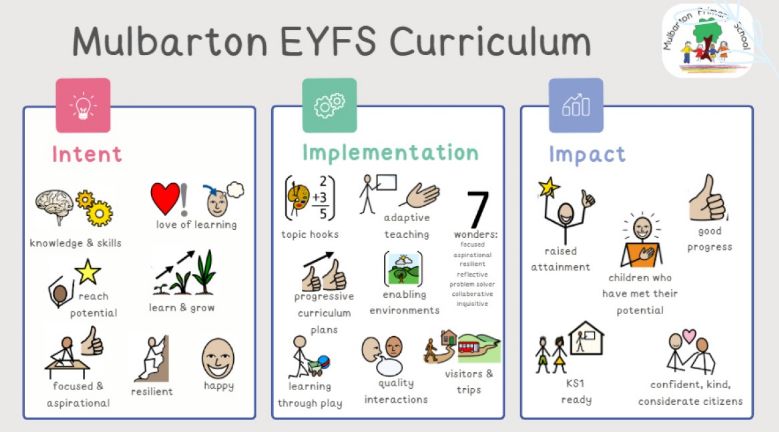
The EYFS framework includes 7 areas of learning and development that are equally important and interconnected. However, 3 areas known as the prime areas are seen as particularly important for igniting curiosity and enthusiasm for learning, and for building children’s capacity to learn, form relationships and thrive.
The prime areas are:
-
Personal, social and emotional development
-
Physical development
-
Communication and language
The prime areas are strengthened and applied through 4 specific areas:
-
Literacy (Reading & Writing)
-
Mathematics
-
Understanding the world
-
Expressive arts and design
|
|
|
|


Personal, social and emotional development
Children are enabled to be safe, happy, and independent at Mulbarton Primary School. Self-regulation is encouraged wherever possible, and rules and boundaries are introduced through the modelling of positive behaviour. The school teaches important values through it’s ‘7 Wonders of Learning’ and the Zones of Regulation curriculum is taught to the children weekly. As part of the personal, social and emotional development offer, a ‘child of the day’ is selected to sit in a special chair, complete special jobs, and receive compliments from teachers and peers. Emotions and feelings are frequently explored through the Zones of Regulation and through stories.
Physical Development
The stunning outdoor environment and woodland area are utilised to make full use of the outdoors, and children are encouraged to play outside as frequently as possible. It is intended that children will develop their gross motor skills and learn to take measured risks when using the large play equipment, construction materials, woodwork bench, and loose parts in the woodland. Weekly sessions using the bikes and the adventure playground are also provided.
The Get Set 4 PE curriculum is followed, which includes dance and movement, stretching and flexibility, and fundamental PE skills. Fine motor skills are developed through daily ‘dough disco’ sessions and ‘funky finger’ activities.
Communication and Language
Communication and Language are regarded as fundamental to all practice within the Early Years Foundation Stage. Staff are trained in the ShREC approach to ensure that high-quality interactions during play are facilitated. Children are encouraged to listen, think aloud, and communicate appropriately with staff, with one another, and in front of the class. Ambitious vocabulary linked to our topics is taught, supported by widget symbols and British Sign Language signs. Classroom provision areas are enhanced to reflect the topics being taught, with enhancements including role-play, small-world, and story-making opportunities. This enables taught vocabulary to be used and applied.
Talking partners are used during whole-class teaching, and children are encouraged to ask questions and contribute to whole-class and group discussions whenever possible. The Wellcomm intervention is used to identify and address specific needs related to communication and language.
Reading
Children are taught to read and to develop a love of books as soon as they begin school. Books are widely used to enhance the curriculum through literacy, mathematics, and topic sessions. A systematic approach to the teaching of phonics is followed through a scheme called Rocket Phonics, which is based on Letters and Sounds. Daily phonics lessons are delivered for 30–40 minutes, and same-day intervention is provided for children requiring additional phonics support.
In addition to daily phonics, children read one-to-one with an adult once a week and participate in a weekly small-group guided reading session. High-quality decodable books, aligned with the phonics phase being taught, are read. Children are encouraged to take home an age-appropriate book from the school library to promote reading for pleasure. Stories from high-quality, age-appropriate texts are read aloud by teachers at every opportunity, and these books are subsequently used to enhance the learning environment.
Writing
Writing is introduced immediately, and handwriting is taught alongside the Rocket Phonics curriculum. Each child is provided with a Rocket Phonics pupil practice booklet in which print letter formation is taught and phonics learning is applied through the writing of words and dictated sentences. Children’s enjoyment of writing is fostered through Writing Club sessions. Writing Club, based on Greg Botrill’s Drawing Club vision, immerses children in drawing, imagination, and the creation of ‘magic codes’.
The ethos of Drawing Club is combined with the Pathways to Write curriculum within Literacy sessions. At the beginning of the year, individual letter codes are written, progressing to CVC words by Christmas, phrases by Easter, and sentence writing in the Summer Term. Children are also encouraged to write within the provision through learning hooks and enhancements. Writing baskets containing gel pens, notepads, cards and envelopes, a range of pencils, and other stationery are made available across the base.
Mathematics
Mathematics is taught through whole-class instruction, songs, and games. Mathematical enhancement activities are also provided across the various areas of the classrooms, including the outdoor environment. The aim of the mathematics curriculum is for children to develop the ability to subitise small quantities automatically as early as possible. A secure understanding of one-digit numbers is prioritised before progression is made to place value, calculation, and arithmetic later in the year.
At Mulbarton Primary School, the White Rose scheme is used alongside a range of practical resources, including Numicon. Skills and knowledge relating to shape, space, and measure are developed through enhanced provision activities. All children participate in a weekly adult-led mathematics activity. Additional intervention is provided where necessary for children requiring further support with mathematics.
Knowledge and Understanding of the World
Knowledge about the local environment and the wider world is promoted at Mulbarton Primary School. The natural environment is explored, and observations of animals and plants are made within the extensive school grounds, the Reception woodland area, and during visits to Mulbarton Common. All topics include elements of science, geography, or history and are closely linked to the changing seasons. For example, the life cycles of animals and plants are investigated within the topic Roots, Shoots and Muddy Boots, and an understanding of the past is developed through stories within the topic Happily Ever After.
We use the Kapow scheme of work to support our history and geography teaching across the school, and this helps inform our understanding of the world direct instruction in Reception.
Religious Education is taught throughout the year using the Norfolk Agreed Syllabus, and festivals across different religions are studied and compared.
Expressive Arts and Design
At Mulbarton Primary School, opportunities are provided for children to sing songs, make music, dance, and perform with confidence. Regular music lessons are delivered using the Music Express scheme, and access is provided to a stage area with instruments, a home corner, and a role-play area with dressing-up clothes.
Within art and design, a range of artists is explored, regular craft activities are completed, and child-initiated activities are encouraged during continuous provision in the creative areas. Children are taught to use and explore a variety of materials, tools, and techniques safely, experimenting with colour, design, texture, form, and function.
We use the Access Art scheme of work and resources to support our teaching of art and design skills alongside the rest of the school.
 |
|

Quotes from our most recent Ofsted report:
Leaders’ recent and ongoing astute evaluation means children in the early years get a strong start to their education."
"Children receive clear, engaging explanations about words and ideas."
"Staff share useful information with parents. This helps parents support their children’s reading and further learning at home."
"Children present as confident, independent learners.- OFSTED, 2022
|
|
 |
